
Women at the top: the road to successful and equitable companies (interview)
Even though more women have been graduating from higher education than men, and that companies with more female directors perform better, why are there still so few women in in key positions at the top of companies?

10/20/2026

8 min
Share
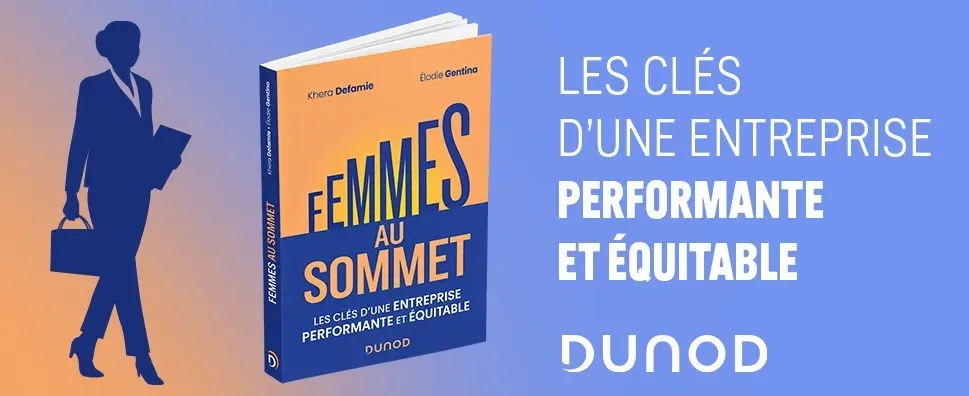
In their new *publication, Professor Elodie Gentina and Khera Defamie (coach, entrepreneur, and public speaker) analyze the roots of these paradoxes and inequalities before proposing individual and organizational solutions and tools to develop women-inclusive companies. In this interview, Elodie Gentina shares the key takeaways from this new book and her reflections on these challenges.
Why did you choose to write this book after several books on Generation Z and intergenerational management?

Elodie Gentina: Our starting point was an extremely powerful paradox that exists today. Women have never been so highly educated, so present in the professional world, or in positions of responsibility. Yet, when we look at the very “top” of organizations, they gradually disappear. In 2025, not a single woman held the position of a CEO—combining both the roles of chairperson and chief executive—within the CAC 40.
So, if women are there, if they’re highly educated, competent, and high-performing, why are so few of them in the positions where decisions are made?
And we wanted to avoid an answer that I find far too easy: telling women that they need to change. For years, they’ve been told: “be bolder,” “be more confident”, “be more ambitious” … Of course, certain individually focused strategies can be helpful. But this approach shifts the blame for their own underrepresentation onto women.
Our book advocates a different idea. We must also look at the system. Historical processes and tools, cultural stereotypes, and the criteria for recruitment, evaluation, promotion, and compensation sometimes—often unconsciously—continue to preserve inequalities. This is precisely one of the book’s central themes: the glass ceiling has an internal dimension, but also an external and organizational one.
And this is where it ties in perfectly with my previous work on generations.
When I work with companies on issues related to Generation Z, I always tell them to be careful not only to ask young people to adapt. If a new generation arrives with a different relationship to authority, work, the collective, or work-life balance, the right question isn’t: “How are we going to make them fit into our model?” It’s also: “What does their arrival tell us about our model and what we might need to change?”
For women, the question is quite similar. The goal isn’t to have women who can succeed in a model historically built around masculine norms. It is to allow a diversity of talents and leadership styles to flourish.
Our book is not a book against men. On the contrary. For me, the polarization between women and men is a dead end. Certain traditional models of power restrict women, but they can also trap men into meeting certain expectations: to be strong, not to show vulnerability, to be competitive, and to have all the answers. Our book shows precisely that this transformation must be collective.
That’s why, for me, the central focus is ultimately “inclusion.”
What are the main strategies and tools you propose for women and men to bring about change?
E.G: Perhaps the book’s primary message is that we must stop assuming the solution rests solely on women.
Of course, the book proposes strategies for women. But if we tell them that they simply need to have more self-confidence or negotiate better… it’s as if we were saying to them: “The system works just fine; it’s up to you to adapt.”
Yet our book shows precisely that the barriers are individual, collective, and organizational. Change must therefore occur at all three levels. The book also proposes several drivers for change and action: reintegrating women into narratives of power, understanding certain mechanisms such as self-censorship or the fear of visibility, and training leadership teams to rethink their decision-making frameworks.
1. The first driver we propose relates to awareness.
We need to understand where our perceptions come from. We all have biases—women and men alike.
When a leader is asked, off the cuff, to think of someone for an executive position, for example, they may more easily picture a man. Not necessarily because they wish to exclude women, but because the historical image of a leader remains strongly masculine.
A story in our book illustrates this very concretely. While working on succession planning, an initial list of candidates consisted entirely of men. By objectively redefining the technical skills, soft skills, and the mindset truly required for the role, several women naturally emerged among the top candidates.
The key is to focus on objectivity rather than stereotypes.
2. The second driver concerns HR processes. And this is where companies have extremely concrete power to act.
It starts right at the recruitment stage: revising job postings, using less gendered language, refocusing criteria on the skills that are truly necessary, structuring interviews more effectively, asking comparable questions of male and female candidates, and creating diverse shortlists… The book also emphasizes the importance of pay transparency and the need to create genuinely safe working environments.
The same logic applies to promotions. We need to examine who is identified as a “high potential,” who is given high-profile assignments, who is encouraged to apply for a position, and what criteria we associate with leadership.
3. The third driver concerns networking, mentoring, and above all, sponsors/support.
There is an important difference between advising someone and using one’s own social capital to advance their career. Telling a woman, “You should apply,” is helpful. Saying to an executive committee, “I think she’s ready for this position, and I support her candidacy,” can change the course of her career. And men have a major role to play here. This is an essential aspect of our book: gender equality cannot be a matter solely for women to address among themselves.
4. Finally, the last driver involves broadening our definition of leadership.
The goal is certainly not to replace a masculine stereotype with a feminine one. To say that “women are empathetic and men are authoritarian” would be to fall right back into the trap we’re denouncing. We advocate for diverse leadership.
A man can be empathetic. A woman can be extremely directive. A young person may value hierarchy. A senior executive may love innovation. Inclusion begins precisely when we stop inferring a person’s qualities based on the category to which they belong.
That’s why the book is ultimately aimed as much at executives and HR directors as it is at women themselves.
So, the real question is no longer: “How can we help women adapt to the system?”
It becomes: “How can we build a system in which all talents can succeed?”
You’re an expert on Generation Z: how does your book address this generation?

E.G: It addresses Generation Z very directly, and particularly young women. However, here again I’d like to avoid oversimplifying: obviously, not all young women in Generation Z think the same way.
Nevertheless, there’s an extremely interesting convergence between the transformations driven by Generation Z and those we describe in our book.
This generation is entering the workforce with high expectations regarding the meaning of their work, work-life balance, the quality of relationships, and collective efforts. They are more likely to question certain traditional models of authority and value more participatory forms of leadership. This is precisely what we explore in the book: Generation Z is helping to make trust, inclusion, and psychological safety the new standards of leadership.
And this profoundly changes the landscape of women’s leadership.
For a very long time, to reach the top, some women had to learn to navigate a system whose rules had historically been established by men. Younger generations are increasingly challenging these norms.
And this is where young women play a particularly interesting role. They’re entering the workforce at a time when, legally speaking, previous generations have won many battles. They study, choose their careers, work, start businesses, and lead.
Yet they will still encounter stereotypes.
A young woman may face preconceived notions about her career path, her legitimacy in tech or finance, or the way she speaks up… Then there are questions surrounding motherhood, availability, or mobility. These biases don’t simply disappear just because a new generation is coming of age.
This is precisely why our book can be helpful to her: understanding these mechanisms prevents her from interpreting them as personal failings.
When a woman hesitates to speak up or apply for a position, the answer shouldn’t automatically be, “She lacks self-confidence.” The book shows that self-censorship, the fear of visibility, or perfectionism must also be understood within a historical and collective context.
But I also want to send a very important message to young men who belong to the Gen Z, because this book concerns them just as much. Equality does not mean taking something away from men to give it to women. That is far too confrontational a view of the issue. Certain traditional codes of masculinity can also weigh heavily on some young men. The need to be strong, high-performing, competitive, hiding their emotions, or viewing vulnerability as a weakness are just some examples. The book demonstrates precisely that certain models of power confine both genders and that transforming them can unleash both feminine and masculine potential.
And this is perhaps where Generation Z can speed things up.
It pushes us to move beyond a binary view: women on one side, men on the other; young people versus older people; “masculine” leadership versus “feminine” leadership.
The leadership of tomorrow won’t be feminine versus masculine. It will likely be much more hybrid, inclusive, and situational. It will allow everyone to draw on different qualities depending on the situation: authority and listening, decision-making and cooperation, ambition and consideration for others, performance and vulnerability.
*Their new book “Femmes au sommet: Les clés d’une entreprise performante et equitable” (Women at the top: the road to successful and equitable companies) is available in French from Editions Dunod.
Contributor

Discover more Insights

Management & Society

Left‑handed people tend to be left‑leaning voters
02/10/2026
6 min

CSR, Sustainability & Diversity
Research in brief: enhancing politicians’ attention through mindfulness practices
28/09/2026
3 min

Economics & Finance
In brief: Why are less people having children in France?
17/09/2026
4 min

CSR, Sustainability & Diversity
Partnerships between government, business and civil society are often tense: 3 tips on how to manage them
15/09/2026
6 min