
Remanufacturing vs recycling: should companies restore old products or create new materials?

09/16/2026

4 min

Share
Growing environmental concerns, stricter regulations, and competitive pressure are driving companies everywhere to adopt product recovery strategies. These include both remanufacturing— restoring used products to a like-new condition—and recycling—transforming old products into new materials.
Companies regularly reassess the emphasis they place on recycling and remanufacturing in their recovery strategies. For example, printing specialist Xerox has prioritized the recycling of solid waste. However, the share of remanufacturing increased from 11% to 15% between 2020 and 2021, while recycling declined from 74% to 69%, before returning to 6% remanufacturing and 81% recycling in 2024.
The automotive group Stellantis, which prioritized remanufacturing, has shifted its strategy toward recycling. The share of recycling for its batteries rose from 28.9% to 43.4% between 2022 and 2023, while the share of remanufacturing declined from 45.6% to 38.1%.
The goal of our research is to help companies build a product recovery strategy that is consistent and resilient over time, to avoid switching back and forth between remanufacturing and recycling driven by short-term constraints.
How did we identify this optimal strategy?
Our study proposes an optimization model to identify the most profitable recovery strategies for original equipment manufacturers (OEMs), which compete with independent remanufacturers. Despite its industrial importance, this economic setting remains understudied. To achieve this, we identified ten possible strategies that range from no product recovery to complete recovery.
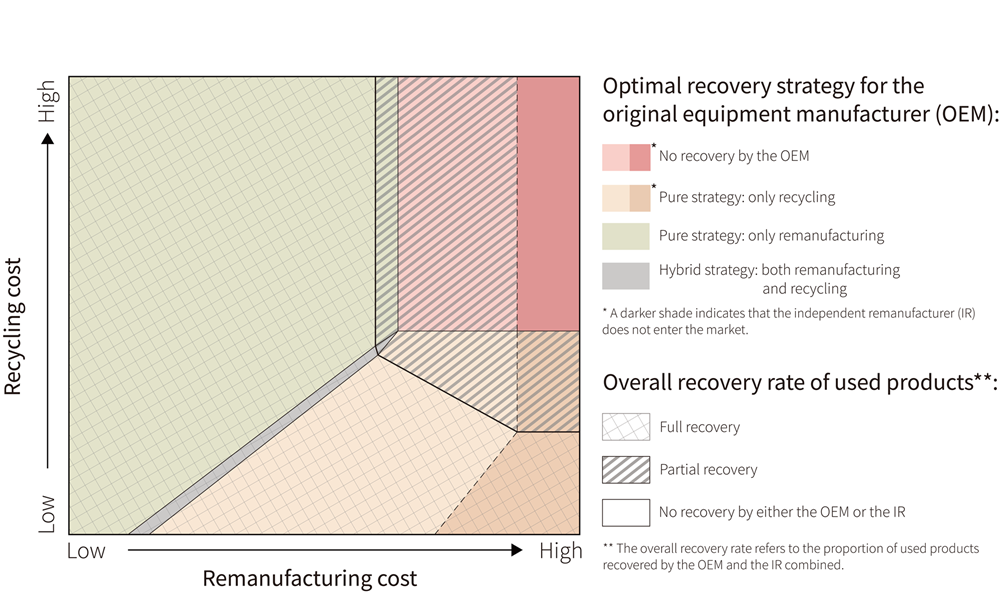
The figure illustrates the ten product recovery strategies (recycling and remanufacturing) for a given set of parameter values.
Such competition already exists in the automotive sector, where several independent remanufacturers are active in the market. Companies such as Terrepower and Borg Automotive compete with original equipment manufacturers (OEMs) like Valeo.
OEMs and independent remanufacturers each decide how many used products to recover. Independent remanufacturers use recovered products for remanufacturing, while original equipment manufacturers can opt for either remanufacturing, recycling, or a combination of the two. The optimal choice depends on competition, costs, and demand.
For example, independent remanufacturers enter the market only if the cost of remanufacturing is below a critical threshold. Companies can identify the most appropriate strategy by varying:
- the costs of producing, collecting, recycling, and remanufacturing a used product;
- the recycled material cost efficiency;
- consumers’ willingness to pay and their degree of acceptance of remanufactured products.
In the electric vehicle battery sector, the cost of remanufacturing is approximately 50% of a new battery, compared to 20% for recycling.
Under these conditions, our model shows that a hybrid strategy is the most profitable, which aligns with the practices observed at Stellantis. When collection costs are high (for heavy and geographically dispersed products), remanufacturing remains prevalent among original equipment manufacturers and independent remanufacturers, as is the case with Caterpillar.
Why is this important?
As the European Union aims to double the circularity rate to 24% by 2030, the recycling and remanufacturing markets are expected to grow. While recycling is already common in industry, remanufacturing is still more limited (about 2% of the manufacturing market), despite its strong potential for sustainability.
Our research shows that policies promoting competition—such as extended producer responsibility or the European Parliament’s 65% collection targets—do not always increase circularity or alter recovery strategies.
We find that competition from independent remanufacturers can increase recycling by original equipment manufacturers and reduce their activities in remanufacturing. This may explain the decline in remanufacturing and the increase in recycling observed at Stellantis.
To mitigate the effects of competition, original equipment manufacturers can act through their product design, which limits remanufacturing by independent remanufacturers. They can also strengthen their brand image, as Volvo has done, or choose to collaborate with or acquire independent remanufacturers, as Caterpillar has done.
This integration increases supply chain profitability (by 7.1% on average) but is not always better for the environment (in 25% of cases).
What are the next steps for this research?
This work is part of a sustainability program. To gain a better understanding of the choices involved in recovery strategies, we have already conducted a complementary project on the role of eco-design, supply uncertainty, consumer greenness, and regulations in these decisions.
We are preparing proposals for national funding for a project on collaboration in circular supply chains, examining multi-stakeholder networks and resilience in the face of uncertainty.
Future research will combine multi-stakeholder case studies, workshops, industry-academia partnerships, and analytical tools, with opportunities for interested companies to participate.
Article by Professors Maud Van den Broeke & Tanja Mlinar & Song Liu, PhD Student (All from IÉSEG School of Management) and Stefan Creemers, Professor, Université catholique de Louvain (UCLouvain)
This is the English translation of an article originally published on the Conversation France.

Contributors


Discover more Insights

Big Data & AI

Vote for the 5 topics you would like us to cover more often
18/09/2025
1 min
Operations
Magic box
28/07/2025
3 min

Entrepreneurship & Innovation
Is R&D taking too long?
11/03/2025
2 min

IT, Technology & Industry

Quantum annealing: a game-changer for complex project management?
21/11/2024
3 min