
What drives local support or opposition to renewable energy projects?
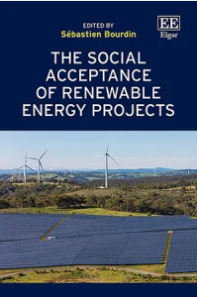
A new book analyses why local communities support or oppose the development of renewable energy projects. Edited by Professor Sebastien BOURDIN, "The social acceptance of renewable energy projects”(Edward Elgar), gathers analysis from nearly 30 experts from different academic fields to shed light on this crucial question.

02/11/2026

min

Share
The development of renewable energy projects has become increasingly important. Governments across the world are responding to climate threats with increasingly ambitious carbon neutrality targets. For example, 2050 in the EU, the United Kingdom, and Canada; 2060 in China; and 2070 in India.
In Europe, the revised Renewable Energy Directive (EU/2023/2413) raises the EU’s binding renewable target for 2030 to a minimum of 42.5% share of renewables in the energy mix.
“Achieving these goals requires a rapid expansion of renewable energy infrastructures such as wind farms, solar arrays, hydroelectric facilities etc. However, technical deployment alone cannot suffice,” explains Sebastien BOURDIN in the book.
Disconnect between national and local levels
Even when there is strong national momentum for implementing energy transition, projects can often meet local resistance. “Although public surveys reveal widespread public support for renewable energy, many projects encounter delays, court challenges, or outright rejection from nearby communities,” adds Professor BOURDIN.
In France, which has experienced delays in expanding development of its wind farms, surveys have shown high levels of public support for this energy. A 2021 survey for the ADEME/ Ministry for Ecological Transition revealed more than 70% support. However, a subsequent barometer led by researchers at Grenoble École de management highlighted that 65% of experts felt a lack of local social support was a major obstacle in deploying this form of energy.
“Local actors frequently express the view that decisions are taken elsewhere – by distant institutions or private developers – without adequate consultation, compensation, or respect for local identities,” explains Professor BOURDIN.
Therefore, resistance can arise because of the way projects are governed or even communicated – despite support for these forms of energy.
Consultation, dialogue, and accountability
“It is common for residents to voice concerns about the degradation of landscapes, noise pollution, perceived health risks, or declines in property values,” he adds. “These anxieties are sometimes compounded by a sense that decisions have been made without adequate consultation, dialogue, or accountability.”
Professor BOURDIN argues that an erosion of trust in public institutions in many countries increases this challenge. “Polarization, inequality, and political fatigue have altered the conditions under which infrastructure projects are debated and accepted.” Public engagement remains essential to ensure legitimacy and stability, yet it often suffers from procedural shortcomings.”
Renewable energy: grasping the complexity of local communities
The expert argues that policymakers must treat social acceptance as a core element of energy planning. Over and above the technical implementation of the projects, they need to grasp the complexity of local support and ensure that they can design participatory processes that are meaningful, inclusive, and responsive.
Drawing on a wide array of case studies and theoretical insights, the book addresses these challenges and provides insights into how projects become legitimate or illegitimate in the eyes of affected communities. It explores the role of institutional frameworks, communication strategies, and benefit-sharing mechanisms.
“More than simple consent, the book argues for a shift toward local appropriation of energy projects, where communities play an active role in shaping trajectories of the energy transition.”
The first part of the new book focuses on understanding the foundations of social acceptance in terms of values and norms. The contributions then focus on the levers of social acceptance- namely stakeholder participation, governance mechanisms, and justice and tools for implementation. Finally, the third part presents a series of case studies drawn from different regions and national contexts.
This book is aimed at researchers, students, policymakers, practitioners, and energy professionals who want to better understand the social foundations of sustainable energy transitions.
Find out more on the Edward Elgar website.
Contributors


Discover more Insights

CSR, Sustainability & Diversity
Remanufacturing vs recycling: should companies restore old products or create new materials?
16/09/2026
4 min

CSR, Sustainability & Diversity
Partnerships between government, business and civil society are often tense: 3 tips on how to manage them
15/09/2026
6 min

CSR, Sustainability & Diversity

Geopolitical risks: What impacts and strategic responses for companies?
07/09/2026
4 min

CSR, Sustainability & Diversity
ESG performance: what is the influence of ESG rating providers?
24/07/2026
4 min