
“Mastering AI for Strategic Business Success”: Interview

12/04/2025

4 min

Share
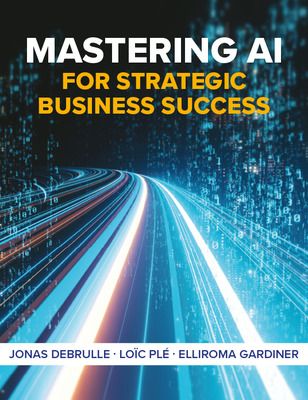
“In the rapidly evolving landscape of modern business, artificial intelligence (AI) has emerged as a transformative force, redefining how organizations operate, compete, and thrive. The advent of AI has introduced unprecedented opportunities and challenges, compelling business leaders to navigate a complex intersection of technology and strategy”, note the publishers of a new book ‘Mastering AI for Strategic Business Success’ (McGraw Hill).
The book – written by Jonas DEBRULLE, Loic PLÉ (both from IÉSEG), and Elliroma GARDINER (QUT Business School) – aims to provide managers and future managers, the tools and perspectives necessary to harness the power of AI responsibly, ethically, and effectively. In this interview, the two IÉSEG professors talk about their reasons for writing this book and look at some of the key takeaways.
What motivated you to write this new book?
Jonas DEBRULLE & Loïc PLÉ: Over the last several years, we observed a growing disconnect between the speed at which AI was reshaping business reality, and the level of understanding managers had about what AI actually does. As strategy professors, this became increasingly evident in the classroom with students, in executive education contexts, and in discussions with firms: AI was everywhere in discourse, yet very poorly understood in practice.
Leaders intuitively recognized AI’s importance but lacked the grounding needed to judge what was hype, what was possible, and how to evaluate strategic trade-offs. And students preparing to become the next generation of managers faced exactly the same challenge.
This sparked a simple but powerful realization: if current and future business leaders do not understand how AI works, they cannot make informed strategic choices about it.
The ambition of the book therefore became to create a bridge: to demystify AI for those who design strategy, and to ground strategy thinking for those who build AI – whether they are already in leadership roles or still in the process of becoming managers.
We also felt the timing was right. AI had matured enough for strategic integration to be meaningful, yet most literature still treated AI as either a technical playground for engineers, or a speculative future concept – not as a concrete driver of strategic advantage. We wanted to change that conversation and create a structured, rigorous and accessible way for both professionals and students to enter into dialogue with AI rather than observe it from a distance.
Who is the book aimed at and how does it differ from other business books on AI?

JD & LP: The book is written for management students, technically oriented learners, and professionals in strategic or managerial roles – in other words, people who (will) have to decide how their organizations respond to AI, not only implement it.
For students, it provides the foundations of AI in a way that supports strategic thinking rather than replacing it with technical abstraction. For those with a technical background, it widens the perspective: this is not just about building AI systems, but about understanding where and why these systems actually matter strategically. And for managers, it offers structured guidance to apply AI responsibly and effectively in competitive settings.
What makes the book distinct is that it explicitly treats AI as a strategic force – not simply as a set of tools or inspirational examples. There are not many business books on AI yet, and even fewer that systematically connect AI with core strategic frameworks, industry dynamics, value chains, ecosystems, business models, and institutional forces. Our book integrates both domains rather than placing one on top of the other. By mixing conceptual clarity, strategy theory, real-world cases and foundational understanding of AI, the book offers a unified lens that helps readers understand what AI means for strategy – and what strategy means for AI.
Can you give some key takeaways on how companies can look to create an effective bridge between strategy and AI?

JD & LP: To connect AI to strategic impact, companies need to identify where AI can genuinely strengthen advantage. This begins with a prioritization mindset: not every use case should be pursued, and not every firm needs to apply AI in the same way. We propose that organizations clarify which role(s) they want AI to play – strategic analyst, enabler, collaborator, or dynamic learning partner – and then design initiatives accordingly. Because resources, skills and data are limited, focus becomes essential.
We illustrate this through our neural network structure: AI technologies form the input layer; strategy mechanisms such as competitive forces, business models, ecosystems and the value chain represent the hidden layers; and the strategic roles played by AI for the firm represent the output layer. Understanding how these layers connect allows companies to move beyond isolated pilots and towards AI-augmented strategies that actually change how the firm competes.
But intent alone is not enough: this must translate into implementation discipline. Strategic choices on AI must be matched with organizational design, capability building, governance and investment decisions. Firms need to embed AI into workflows, decision rights, processes and routines so that AI does not remain a parallel digital experiment, but becomes a core strategic capability.
Finally, bridging AI and strategy also means integrating external forces into decision-making. Institutional environments, regulation and societal expectations determine which strategic moves are viable. Strategy and AI therefore must evolve together, not in parallel, and firms that can orchestrate this alignment intentionally (from technology to organizational structure to ethics and compliance) will be best positioned to turn AI from an abstract topic into a durable source of competitive advantage.
More information on their new book: Mastering AI for Strategic Business Success (McGraw Hill) is available on the McGraw Hill website.
Image at top of the page: Istock : metamorworks
Contributors


Discover more Insights

Big Data & AI

Are we more likely to believe AI when it is wrong?
25/08/2026
3 min

Big Data & AI

Summer reads: some books from our faculty
19/06/2026
3 min

Big Data & AI
Gender inequalities: how does AI & technology impact careers and domestic lives?
25/03/2026
5 min
Big Data & AI
International Women’s Day: “(Un)equal futures? AI’s impact on careers and societies” (online event – 9th March)
12/02/2026
1 min